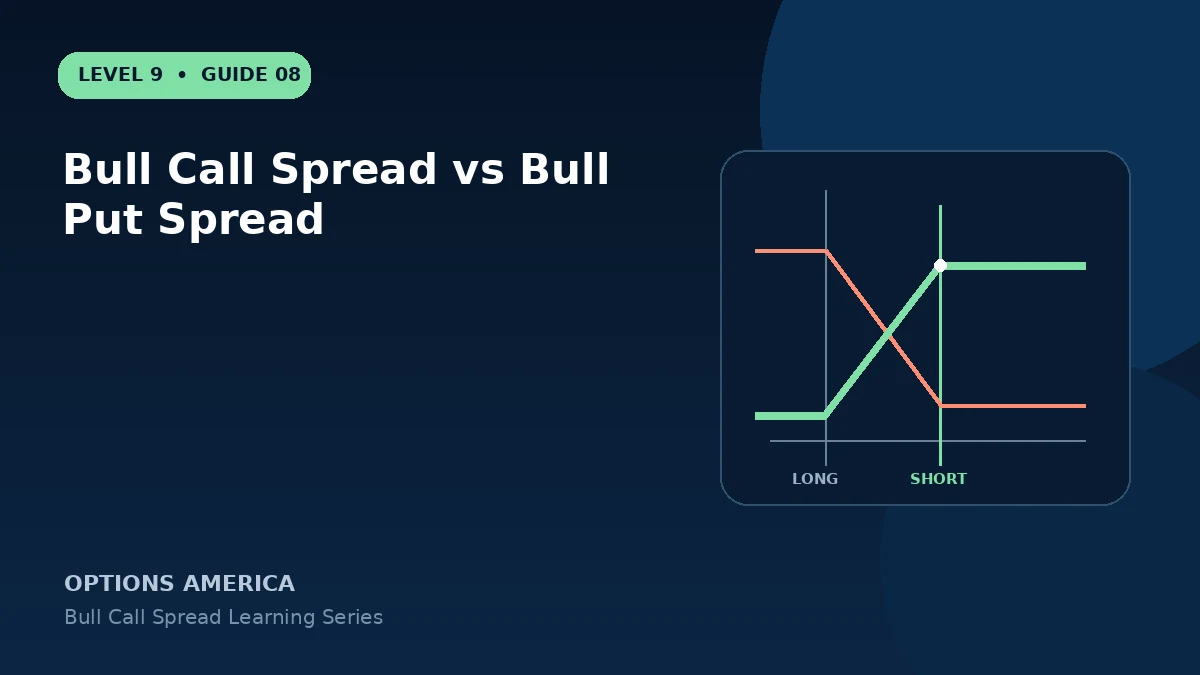
Compare two defined-risk bullish vertical spreads through debit versus credit, payoff, assignment, volatility and buying-power treatment.
Debit versus credit
A bull call spread is usually opened for a debit with calls. A bull put spread is usually opened for a credit with puts. Cash flow at entry does not determine whether one strategy is safer.
Payoff location
A bull call spread needs price above its breakeven to profit at expiration. A bull put spread can profit if price stays above its breakeven, which may sit below the current stock price depending on its strikes.
Greeks and volatility
Both normally have positive delta. Their theta and vega profiles can differ materially: the call debit spread often begins with negative theta and positive vega, while the put credit spread often reverses those signs.
Assignment and capital
American-style short options can be assigned before expiration. Broker buying-power treatment, dividends and exercise outcomes should be compared before choosing between equivalent-looking spreads.
A practical example
A trader can compare a 100/110 call debit spread with a 100/90 put credit spread. Both are bullish, but the stock levels required for maximum profit and the time-volatility exposures differ.
This simplified example focuses on the spread at a specific moment and expiration outcome. Live option prices also reflect the underlying price, time decay, rates, dividends, liquidity and transaction costs. Greeks are theoretical estimates, not guarantees.
Frequently asked questions
Are the strategies identical?
No. They may be synthetically related in some configurations, but strikes and pricing matter.
Which receives premium?
The bull put spread normally opens for a credit.
Which has positive theta?
Often the bull put spread, but live Greeks can change.
Continue the Bull Call Spreads cluster
Explore related guides: Bull Call Spread vs Covered Call · When to Close a Bull Call Spread · Bull Call Spread Profit, Loss and Breakeven. For a structured sequence, use the free Level 9 – Bull Call Spread Strategy course.
Options involve risk and are not suitable for every investor. This material is educational and is not investment, tax or legal advice. Greeks are theoretical estimates, and contract terms and broker requirements can vary.