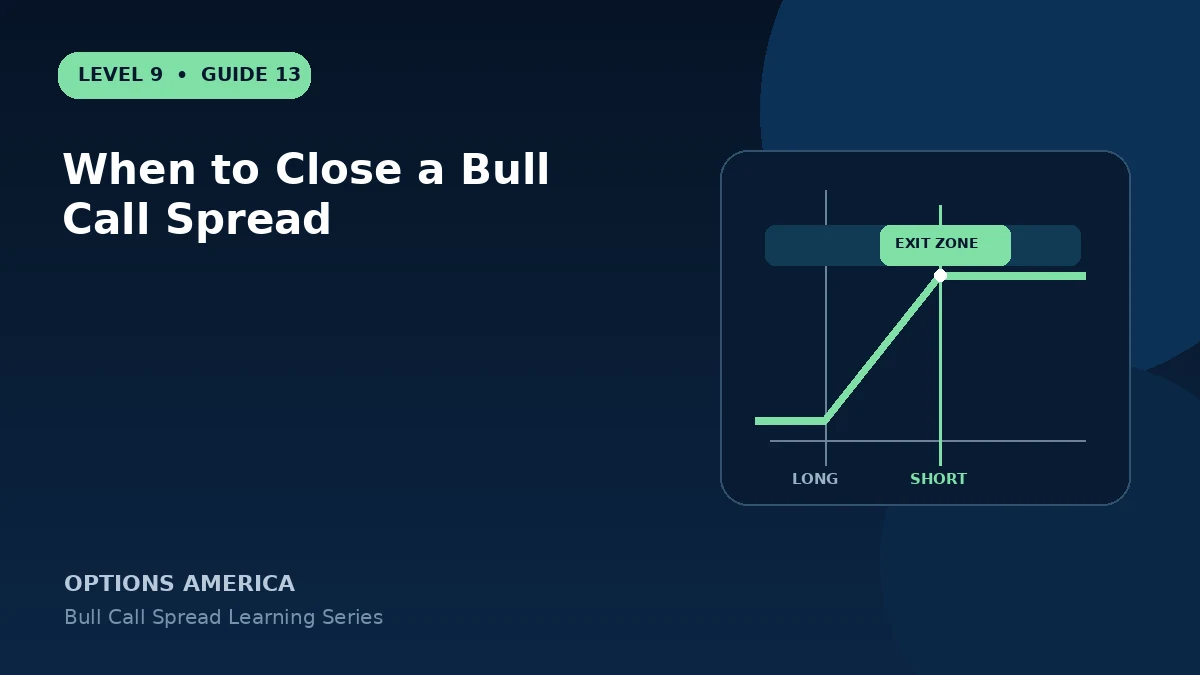
Create profit, loss, time and event exits for a bull call spread instead of relying on hope or holding automatically to expiration.
Profit target
Consider closing after capturing a chosen portion of maximum profit, especially when little additional reward remains relative to the risk of reversal. Use an executable spread price rather than the stock price alone.
Loss or thesis exit
Exit when the original price or timing thesis is invalidated. The defined maximum loss is a boundary, not a requirement to hold until every dollar is lost.
Time-based exit
If the expected move has not appeared by a selected date, remaining theta and gamma may no longer justify staying. A time stop prevents repeated extensions of a failed forecast.
Events and expiration
Close or reassess before earnings, dividends or expiration when those risks were not part of the plan. Use a multi-leg limit order and confirm both legs have closed.
A practical example
A spread has reached $8.50 of its $10 maximum value with two weeks remaining. Closing realizes most of the opportunity while removing the risk of losing that gain during a reversal.
This simplified example focuses on the spread at a specific moment and expiration outcome. Live option prices also reflect the underlying price, time decay, rates, dividends, liquidity and transaction costs. Greeks are theoretical estimates, not guarantees.
Frequently asked questions
Must I hold until expiration?
No. Bull call spreads can be closed before expiration.
How is the spread closed?
Sell the long call and buy back the short call, normally as one order.
What if only one leg fills?
The remaining option changes the risk profile, so order status must be checked.
Continue the Bull Call Spreads cluster
Explore related guides: How to Adjust a Bull Call Spread · Bull Call Spread Profit, Loss and Breakeven · Bull Call Spread vs Bull Put Spread. For a structured sequence, use the free Level 9 – Bull Call Spread Strategy course.
Options involve risk and are not suitable for every investor. This material is educational and is not investment, tax or legal advice. Greeks are theoretical estimates, and contract terms and broker requirements can vary.