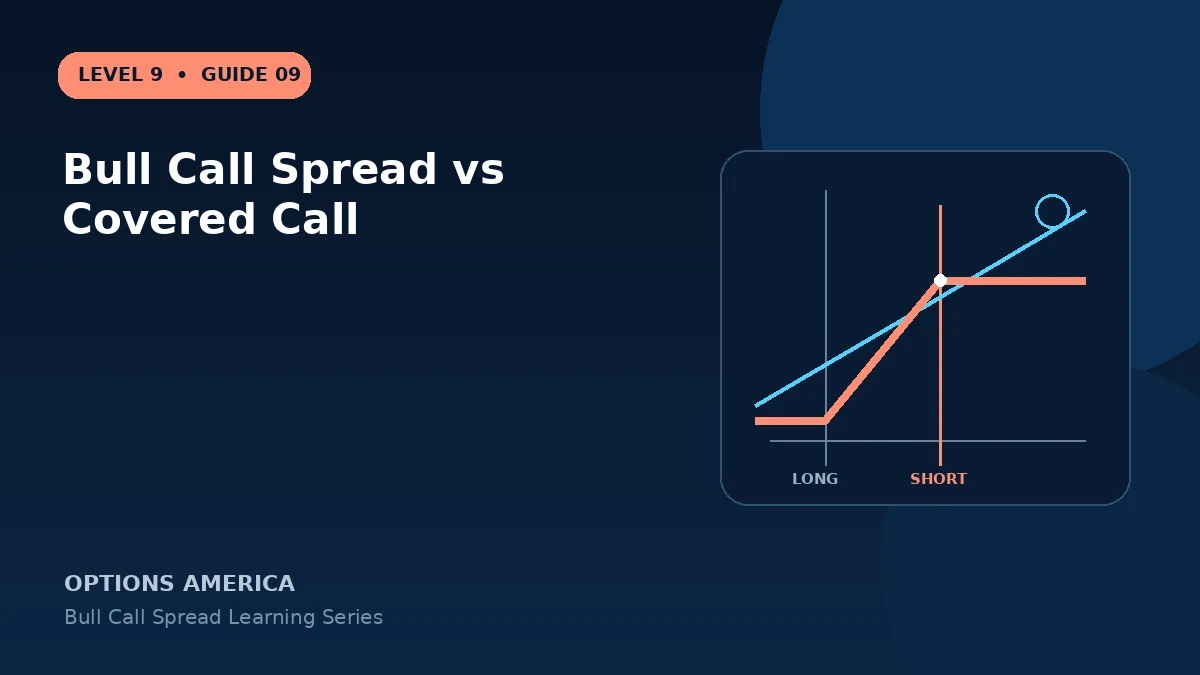
Compare a defined-risk call debit spread with stock plus a short call across capital, downside exposure, dividends and return profile.
Position construction
The bull call spread uses two calls and no stock. A covered call owns 100 shares per standard short call. These are different capital and portfolio exposures even when both have capped upside.
Downside risk
The spread's loss is limited to the debit. A covered call can lose substantially if the shares decline; the premium only provides a small downside cushion relative to stock ownership.
Income and participation
A covered call can receive dividends and behaves largely like stock below the short strike. A call spread has a nonlinear payoff and may expire worthless if price does not exceed the long strike.
Choose by objective
Use capital, stock-ownership intent, downside tolerance, tax considerations and target price to compare them. Neither strategy is simply a higher-yield version of the other.
A practical example
At $100, a covered call may require roughly $10,000 of stock before premium, while a 100/110 call spread may risk only its several-hundred-dollar debit.
This simplified example focuses on the spread at a specific moment and expiration outcome. Live option prices also reflect the underlying price, time decay, rates, dividends, liquidity and transaction costs. Greeks are theoretical estimates, not guarantees.
Frequently asked questions
Does a covered call have defined risk?
Its upside is capped, but stock downside remains substantial.
Does the spread receive dividends?
No, option ownership does not create shareholder dividend rights.
Which uses less capital?
The call spread commonly requires much less upfront capital.
Continue the Bull Call Spreads cluster
Explore related guides: Bull Call Spread Greeks: Delta, Gamma, Theta and Vega · How to Adjust a Bull Call Spread · Bull Call Spread Example With Full Payoff Scenarios. For a structured sequence, use the free Level 9 – Bull Call Spread Strategy course.
Options involve risk and are not suitable for every investor. This material is educational and is not investment, tax or legal advice. Greeks are theoretical estimates, and contract terms and broker requirements can vary.