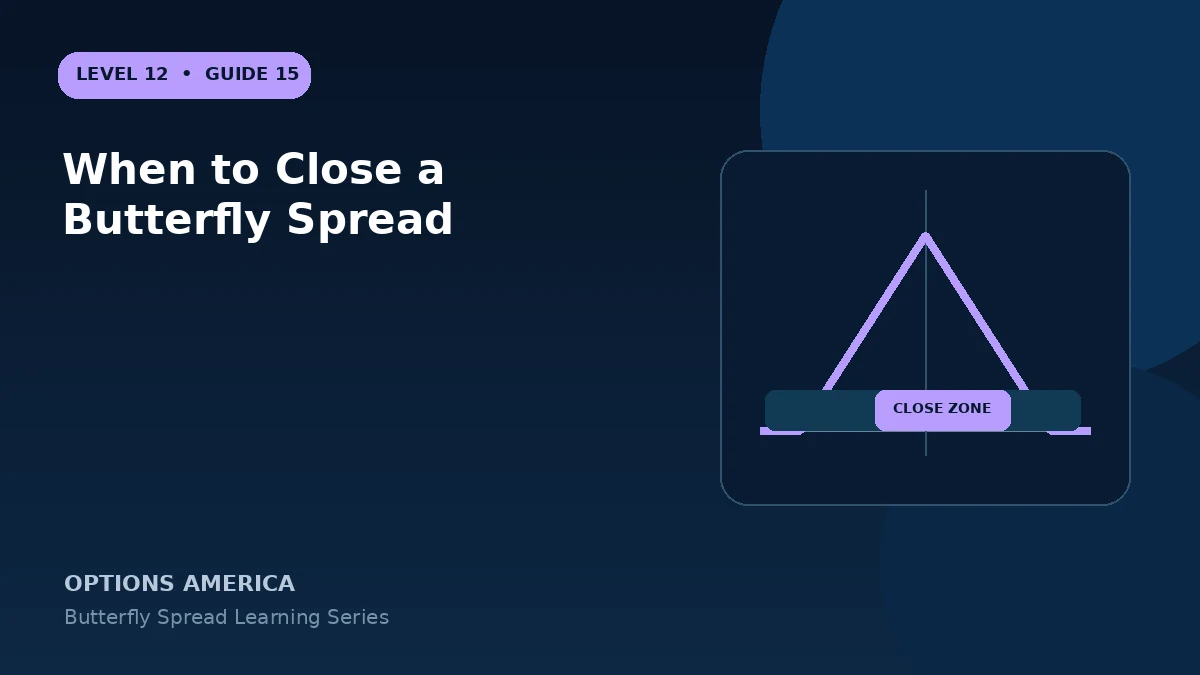
Plan price, profit, loss, time and event exits for a butterfly instead of depending on a perfect expiration pin.
Profit target
Consider closing after capturing a chosen portion of the maximum realistic value. Near the target, the last theoretical dollars may require holding concentrated gamma and assignment risk.
Target failure
Exit or reassess if the expected price path, catalyst or timing is invalidated. The small defined debit can still represent a 100% position loss.
Time exit
A target reached too early may not deliver the expiration peak because extrinsic values remain. Set a management date and compare current closing value with the risk of waiting.
Expiration risk
Two short body options can be assigned, and pinning near a strike can produce uncertain stock positions. Close before expiration when exercise outcomes are not intended.
A practical example
A butterfly bought for $1.20 trades at $3.40 near the body with days remaining. Closing captures $220 while avoiding the risk of a fast move that returns it toward the $120 loss.
This simplified example focuses on one structure and selected expiration outcomes. Live option prices also reflect the underlying price, time decay, rates, dividends, liquidity and transaction costs. Greeks are theoretical estimates, not guarantees.
Frequently asked questions
Must I wait for the body strike?
No. The position can be closed at any executable value.
Why not hold for maximum profit?
It is concentrated at one price at expiration.
How is it closed?
Use a closing multi-leg order and confirm all legs fill.
Continue the Butterfly Spreads cluster
Explore related guides: Butterfly Spread: 12 Mistakes to Avoid · Butterfly Spread Example With Full Payoff Scenarios · Butterfly Spread vs Iron Condor. For a structured sequence, use the free Level 12 – Butterfly Spread course.
Options involve risk and are not suitable for every investor. This material is educational and is not investment, tax or legal advice. Greeks are theoretical estimates, and contract terms and broker requirements can vary.