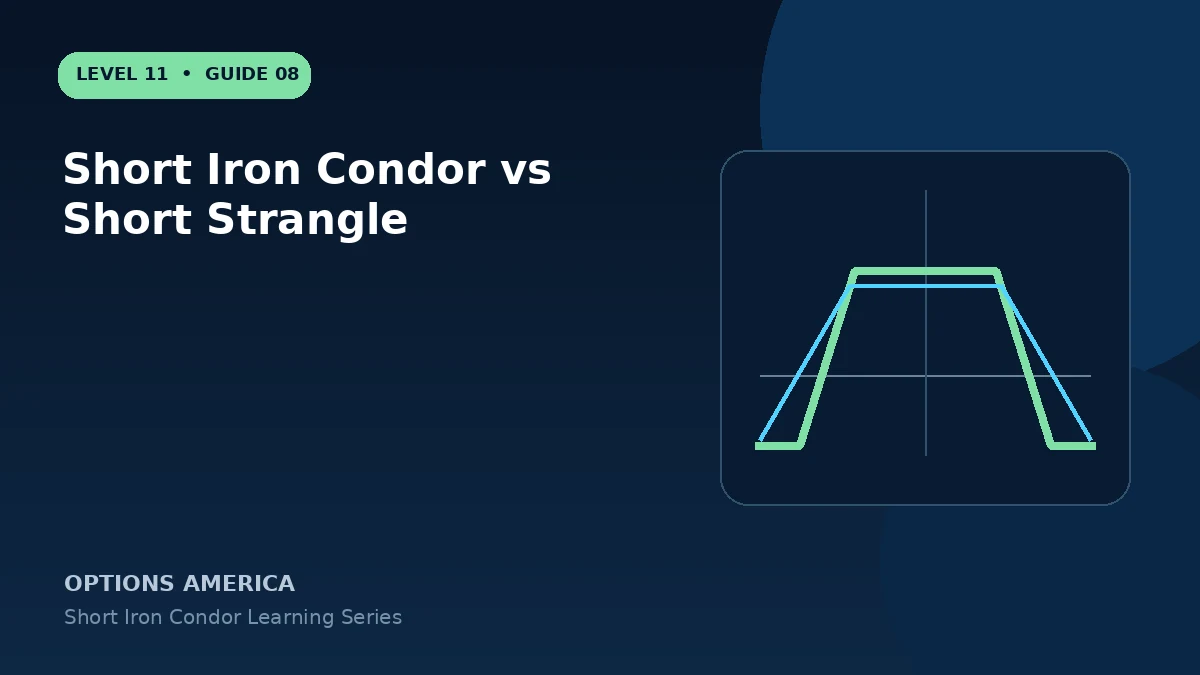
Compare two neutral premium strategies across credit, maximum loss, buying power, Greeks, adjustment flexibility and tail risk.
Construction
Both sell an OTM put and OTM call. The condor adds a farther OTM long put and long call, reducing credit while capping losses beyond the wings.
Capital and risk
Defined risk can reduce buying-power requirements, depending on the broker. A short strangle can suffer very large downside losses and theoretically unlimited upside loss from the uncovered call.
Greeks and management
Long wings reduce net negative vega, negative gamma and positive theta. They also change adjustment economics because rolling one side can alter width and defined-risk status.
Decision framework
Compare expected range, volatility, account permissions, stress loss and liquidity. A larger strangle credit is compensation for a fundamentally different tail-risk profile.
A practical example
A short strangle collects $3.20. Adding two $0.45 wings creates a condor for $2.30 credit and transforms open-ended tail risk into known maximum losses.
This simplified example focuses on one position and a limited set of price and volatility outcomes. Live option prices also reflect the underlying price, time decay, rates, dividends, liquidity and transaction costs. Greeks are theoretical estimates, not guarantees.
Frequently asked questions
Which collects more credit?
Normally the short strangle.
Which has defined risk?
The iron condor.
Are the long wings free?
No. Their cost reduces the net credit.
Continue the Short Iron Condor cluster
Explore related guides: Iron Condor vs Iron Butterfly · How to Adjust a Short Iron Condor · Short Iron Condor Profit, Loss and Breakevens. For a structured sequence, use the free Level 11 – Short Iron Condor course.
Options involve risk and are not suitable for every investor. This material is educational and is not investment, tax or legal advice. Greeks are theoretical estimates, and contract terms and broker requirements can vary.
Undefined-risk comparison: Read the Short Strangle guide and take the free Level 16 course.