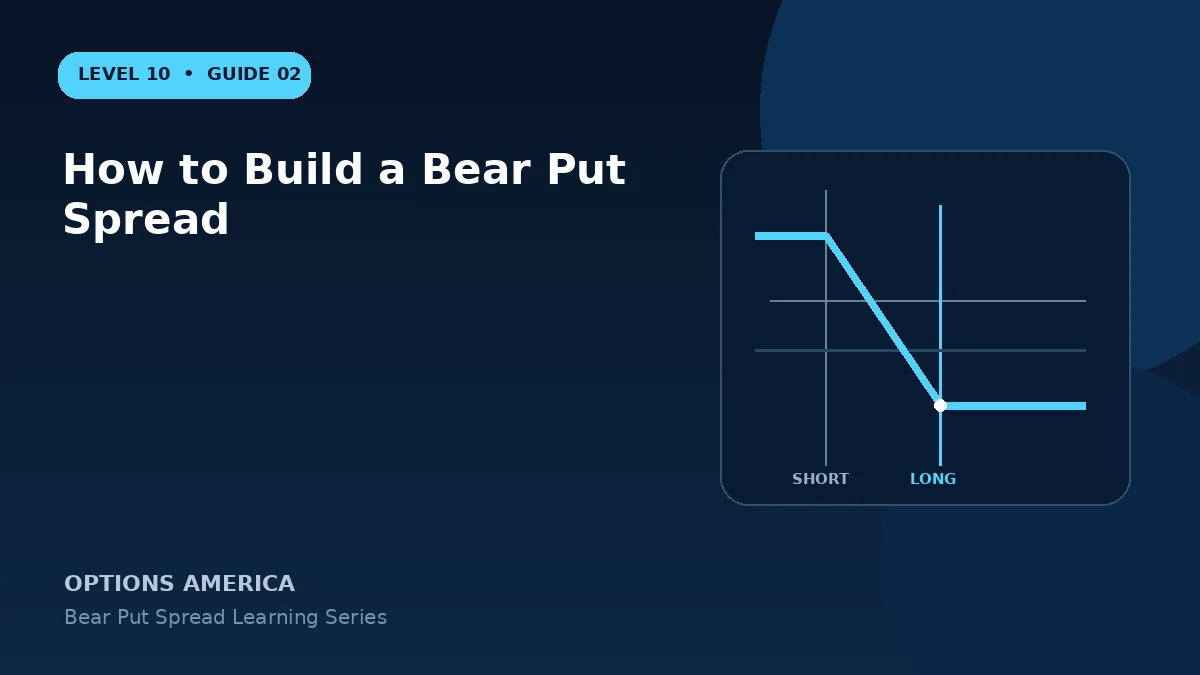
Follow a practical process for selecting an underlying, buying the higher-strike put and selling the lower-strike put as one order.
Write a measurable thesis
State the expected decline, target price, catalyst and time window before opening the option chain. These assumptions determine whether the capped payoff is appropriate.
Select matching contracts
Use the same underlying, expiration and contract multiplier. Buy the higher strike and sell the lower strike in equal quantity, then confirm the ticket identifies a vertical put debit spread.
Use a net-debit limit
Submit both legs together with a limit price. Legging can expose the account to slippage, temporary naked risk and a very different debit from the one originally modeled.
Document the management plan
Record maximum loss, maximum profit, breakeven, profit target, thesis exit, time exit and known events. Review liquidity, commissions, assignment and expiration procedures for both legs.
A practical example
With shares at $102 and a six-week target of $92, a trader buys the 100 put and sells the 90 put together for a $3.25 net debit.
This simplified example focuses on the spread at a specific moment and expiration outcome. Live option prices also reflect the underlying price, time decay, rates, dividends, liquidity and transaction costs. Greeks are theoretical estimates, not guarantees.
Frequently asked questions
Which put is purchased?
The higher-strike put is purchased and the lower-strike put is sold.
Must quantities match?
A standard one-to-one spread uses equal quantities.
Why enter one order?
It controls the net debit and avoids unintended single-leg exposure.
Continue the Bear Put Spreads cluster
Explore related guides: Bear Put Spread Profit, Loss and Breakeven · Bear Put Spread vs Long Put · Time Decay in a Bear Put Spread. For a structured sequence, use the free Level 10 – Bear Put Spread course.
Options involve risk and are not suitable for every investor. This material is educational and is not investment, tax or legal advice. Greeks are theoretical estimates, and contract terms and broker requirements can vary.