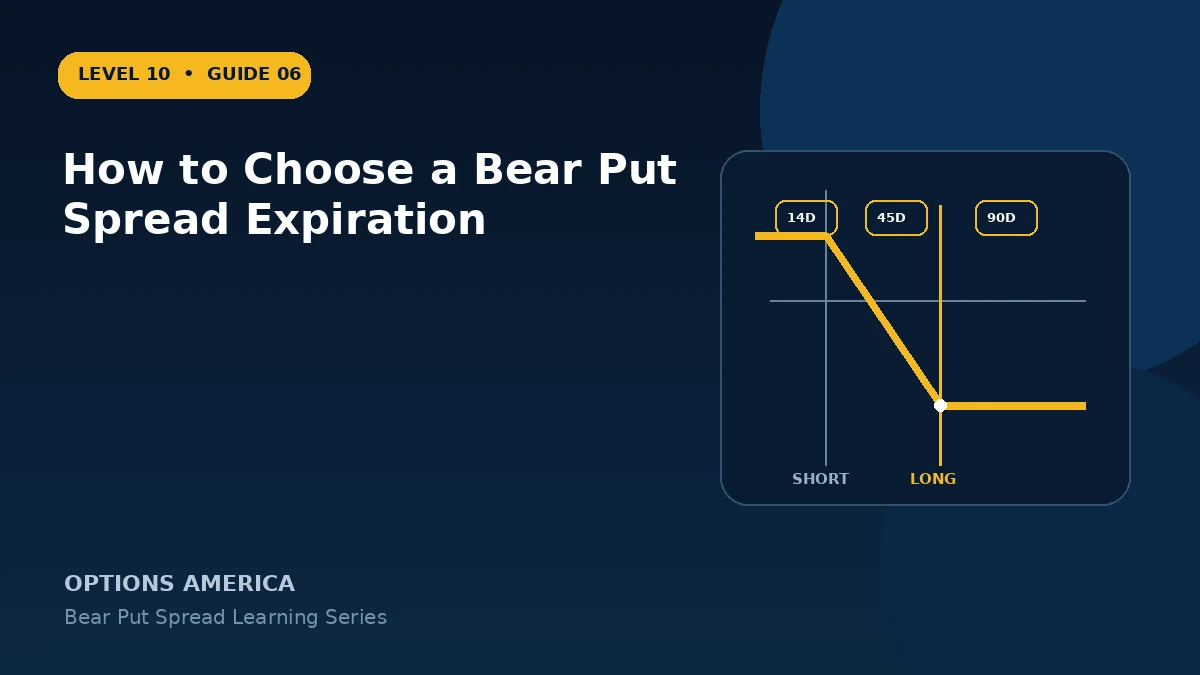
Match expiration to the bearish thesis while balancing time cost, theta, event risk, liquidity and the expected timing of the decline.
Match the catalyst
Choose an expiration after the anticipated move with a buffer for timing uncertainty. A correct bearish forecast can still lose if the decline arrives after expiration.
Compare durations
Near-term spreads cost less but carry faster gamma and theta changes. Longer-dated spreads may tolerate timing error but use more capital and can be more sensitive to volatility.
Review events
Earnings, economic releases and dividends can change volatility and early-assignment risk. Model both the price reaction and the possible volatility decline after the event.
Set a time exit
Decide when the trade will be reassessed if the decline does not occur. Exiting before the final days can reduce gamma, liquidity and expiration-management risk.
A practical example
For a bearish catalyst expected in five weeks, compare expirations six, eight and twelve weeks away using live debit, Greeks and open interest.
This simplified example focuses on the spread at a specific moment and expiration outcome. Live option prices also reflect the underlying price, time decay, rates, dividends, liquidity and transaction costs. Greeks are theoretical estimates, not guarantees.
Frequently asked questions
Is the nearest expiration cheapest?
Often, but it also provides the least time.
Do longer spreads have more vega?
Often, though the short leg offsets part of it.
Must it be held to expiration?
No. A planned early exit is common.
Continue the Bear Put Spreads cluster
Explore related guides: Bear Put Spread vs Long Put · How Implied Volatility Affects a Bear Put Spread · Bear Put Spread Explained: Strategy, Risk and Reward. For a structured sequence, use the free Level 10 – Bear Put Spread course.
Options involve risk and are not suitable for every investor. This material is educational and is not investment, tax or legal advice. Greeks are theoretical estimates, and contract terms and broker requirements can vary.