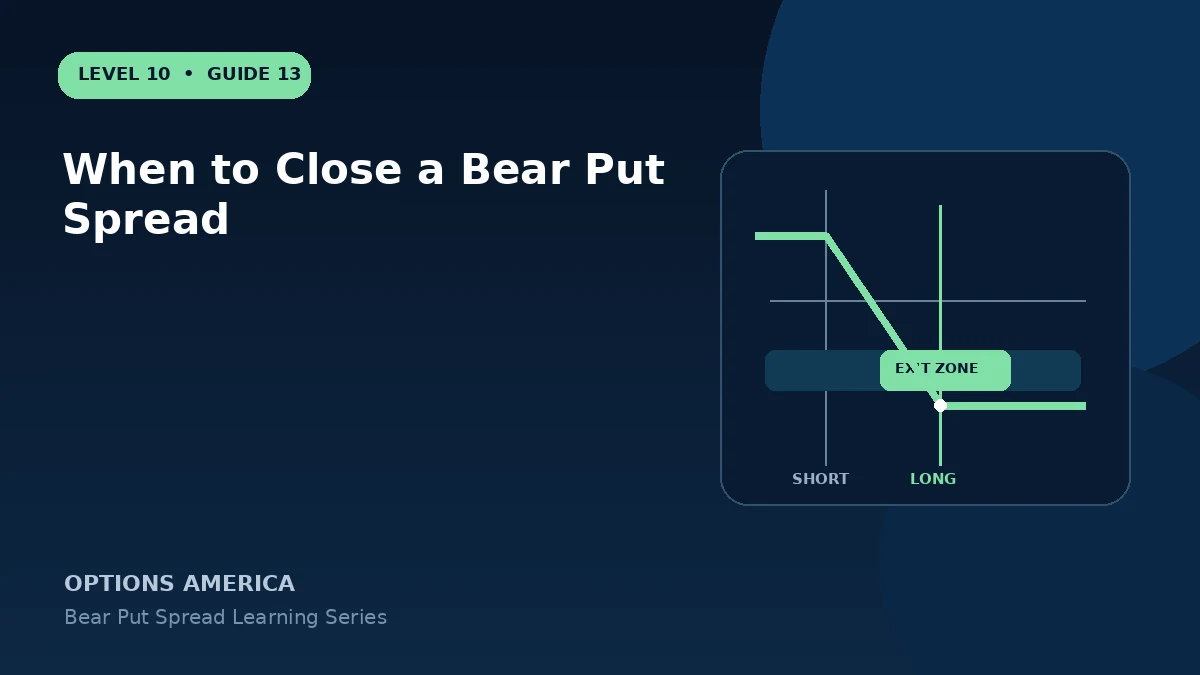
Plan profit, loss, time and event exits for a bear put spread instead of automatically holding until expiration.
Profit exit
Consider closing after capturing a chosen percentage of maximum profit, especially when little reward remains compared with reversal risk. Price the complete spread using executable markets.
Thesis or loss exit
Close when the expected decline, catalyst or timing assumption is invalidated. Defined maximum loss is a boundary, not an instruction to lose the entire debit.
Time exit
If the decline has not developed by the planned date, the remaining theta and gamma profile may be unattractive. Avoid repeatedly extending a failed forecast without a fresh analysis.
Expiration and assignment
Close or actively manage ITM spreads before expiration when exercise and assignment are unwanted. Confirm that both legs filled and no residual option or share position remains.
A practical example
A $10-wide spread trades at $8.70 with two weeks left. Closing captures most of the available value and removes the risk that a sharp rebound erases the gain.
This simplified example focuses on the spread at a specific moment and expiration outcome. Live option prices also reflect the underlying price, time decay, rates, dividends, liquidity and transaction costs. Greeks are theoretical estimates, not guarantees.
Frequently asked questions
Must it be held to expiration?
No.
How is it closed?
Sell the long put and buy back the short put, preferably as one order.
Why verify fills?
A partial fill changes the exposure and can leave an unintended short put.
Continue the Bear Put Spreads cluster
Explore related guides: How to Adjust a Bear Put Spread · Bear Put Spread Profit, Loss and Breakeven · Bear Put Spread vs Bear Call Spread. For a structured sequence, use the free Level 10 – Bear Put Spread course.
Options involve risk and are not suitable for every investor. This material is educational and is not investment, tax or legal advice. Greeks are theoretical estimates, and contract terms and broker requirements can vary.