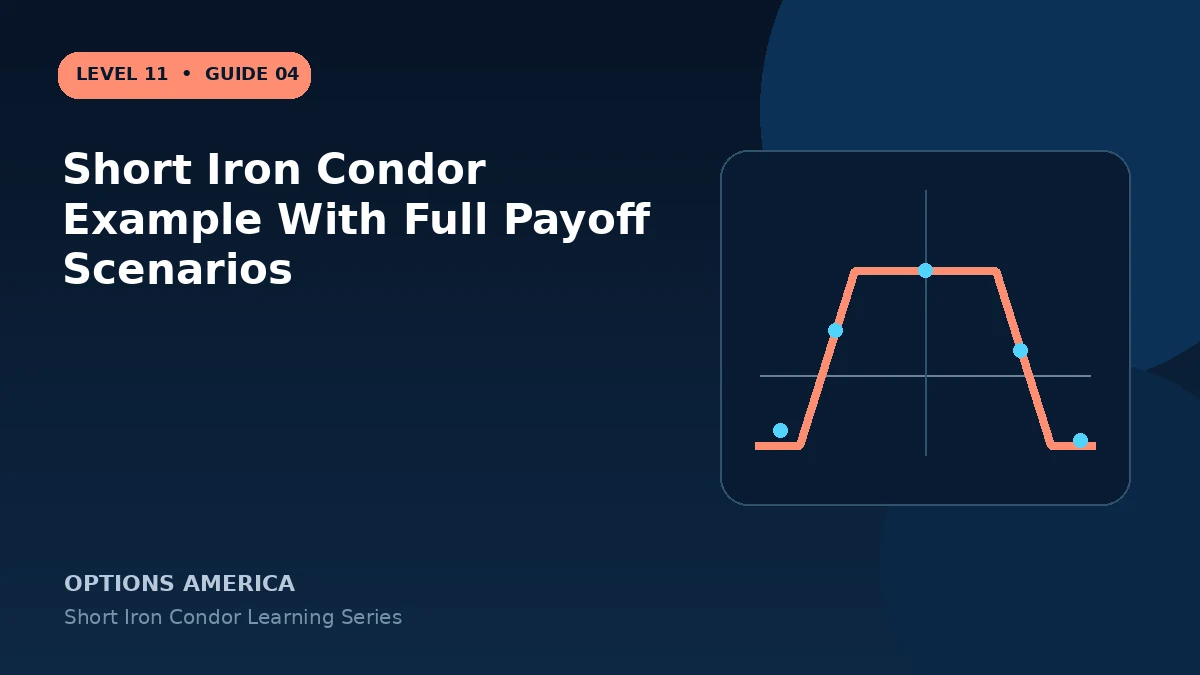
Follow a complete iron condor example across prices below, inside and above its profit range at expiration.
Set up the trade
Assume stock is $100. Buy the 90 put, sell the 95 put, sell the 105 call and buy the 110 call for a net $1.40 credit. Each side is five points wide.
Inside the range
Between $95 and $105 at expiration, all options expire worthless and the $140 credit is maximum profit. At $94 or $106, one short option has $1 intrinsic value, leaving a $40 profit before costs.
Between short and long strikes
At $92, the short put is worth $3 while the long put is worthless. Subtracting $300 from the $140 credit produces a $160 loss. The call side expires worthless.
Beyond a long wing
At $88 or $112, one vertical spread is worth its full $5 width. The defined expiration loss is $500 minus the $140 credit, or $360.
A practical example
At expiration prices of $88, $92, $100, $108 and $112, approximate P&L is −$360, −$160, +$140, −$160 and −$360 before costs.
This simplified example focuses on one position and a limited set of price and volatility outcomes. Live option prices also reflect the underlying price, time decay, rates, dividends, liquidity and transaction costs. Greeks are theoretical estimates, not guarantees.
Frequently asked questions
What happens exactly at a short strike?
The full credit is normally retained at expiration, ignoring costs.
Can it be closed early?
Yes, by buying back the complete condor.
Why model five prices?
It reveals the plateau, transition zones and capped losses.
Continue the Short Iron Condor cluster
Explore related guides: How to Choose Short Iron Condor Strikes · Iron Condor vs Iron Butterfly · When to Close a Short Iron Condor. For a structured sequence, use the free Level 11 – Short Iron Condor course.
Options involve risk and are not suitable for every investor. This material is educational and is not investment, tax or legal advice. Greeks are theoretical estimates, and contract terms and broker requirements can vary.