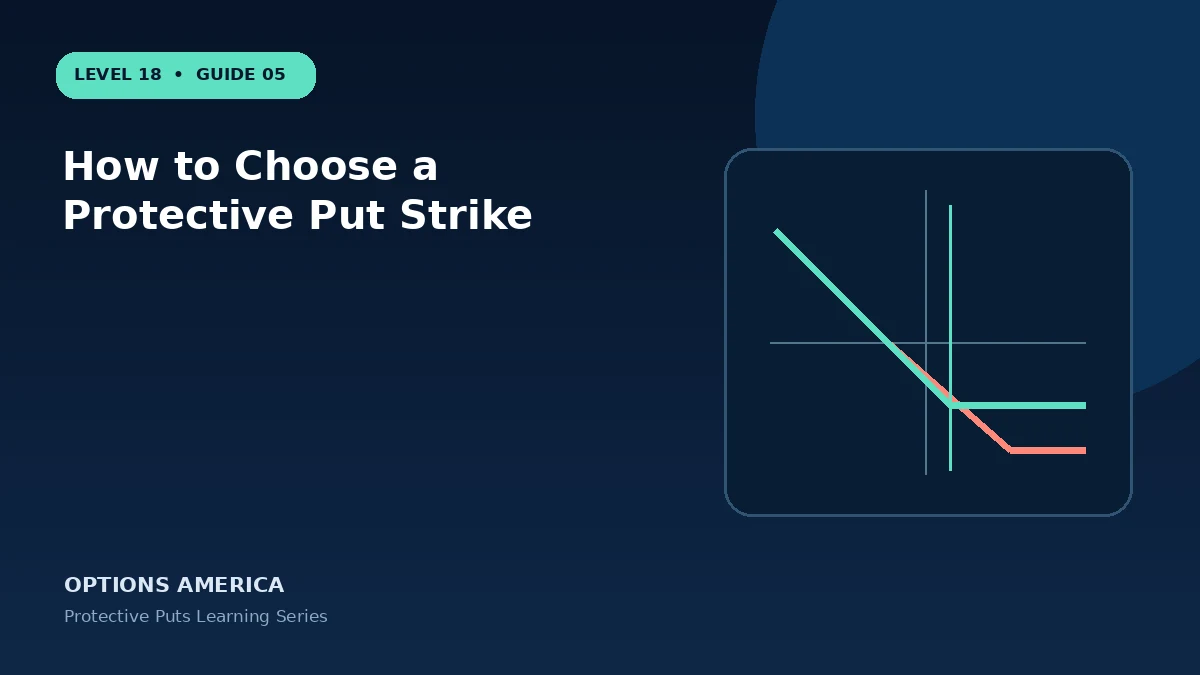
Compare deductible, premium, delta and protection level when selecting a hedge strike.
Plan execution and liquidity
Before entering how to choose a protective put strike, inspect bid-ask spreads, quoted size, open interest and the exact settlement or exercise rules. Use limit orders and confirm each filled quantity. Slippage and partial execution can materially change a multi-leg payoff, especially when markets widen during stress.
Define management before entry
Write a response for three states: thesis working, thesis delayed and thesis invalidated. For how to choose a protective put strike, specify whether each state calls for holding, reducing, closing or replacing exposure. This reduces the temptation to convert a planned trade into an indefinite commitment after a loss.
Start with the objective
The useful starting point for how to choose a protective put strike is the job the position must perform. Compare deductible, premium, delta and protection level when selecting a hedge strike. State the horizon, desired exposure, affordable cost and event being addressed. That written objective makes it possible to compare the strategy with cash, stock or a simpler option structure.
Understand the economic exposure
The central mechanism is simple but the live exposure is dynamic: A higher strike usually provides a tighter floor at a larger premium; a lower strike is cheaper but leaves a larger deductible. Separate intrinsic value from extrinsic value and identify which leg controls the next dollar of risk. Include commissions, exercise or settlement mechanics and capital tied up by the position.
Measure more than one outcome
Stress testing should answer how much the account can lose, when that loss can occur and whether the position can still be closed. For how to choose a protective put strike, combine the wrong direction with a volatility shock and reduced liquidity. A useful test challenges the assumptions that make the base case attractive.
Check the changing Greeks
The Greek profile of protective put is conditional on price, time and volatility. Ask which sensitivity creates profit, which one finances it and which one accelerates loss. That question is more informative than describing the position as simply bullish, bearish, long volatility or hedged.
A practical example
A 98 put costing $4 limits more downside than a 90 put costing $1.50, but raises the portfolio's insurance expense by $250 per contract.
This simplified example is educational and focuses on selected outcomes. Live prices also reflect time, implied volatility, skew, rates, dividends where applicable, liquidity, settlement conventions and transaction costs. Greeks and scenario values are estimates, not guarantees.
Decision checklist
Confirm the market thesis and time horizon. Calculate the full-position payoff and premium at risk. Stress price, volatility and time together. Check contract specifications and settlement. Set the maximum account-level loss, reserve capital and exit trigger. Finally, record the result after closing so the next decision is based on evidence rather than memory.
Frequently asked questions
What is the key idea behind How to Choose a Protective Put Strike?
A higher strike usually provides a tighter floor at a larger premium; a lower strike is cheaper but leaves a larger deductible.
Does the example guarantee a live-market result?
No. It is an educational scenario; live prices, volatility, liquidity, costs and contract terms can change the outcome.
What should be defined before entry?
The objective, size, maximum tolerated loss, review triggers, settlement or assignment plan and exit date.
Continue the Protective Puts cluster
Explore related guides: How to Choose Protective Put Expiration · Protective Put vs Stop-Loss Order · Protective Put Strategy Explained. For a structured sequence, use the free Level 18 – Protective Puts course.
Options and volatility products involve risk and are not suitable for every investor. This material is educational and is not investment, tax or legal advice. Verify current contract specifications with the exchange and your broker.